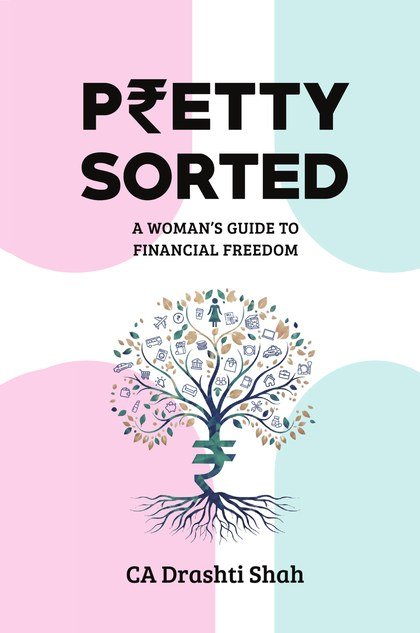
All of this comes from one book
Pretty Sorted is a plain-English guide to money for Indian women, written by a Chartered Accountant and endorsed by Ankur Warikoo.
GLOSSARY
Financial jargon can feel like a foreign language. Every term used in the book, defined in plain English and in Indian context. Bookmark it and come back whenever something does not quite make sense.
Tax paid in instalments through the year, applicable if your liability exceeds ₹10,000.
A tax document on the income-tax portal showing every financial transaction reported against your PAN: salary, interest, dividends, property deals. Worth reading once a year before you file.
The true yearly cost of borrowing, including interest and fees. A credit card advertising 3.5% a month actually works out to roughly 42 to 45% a year.
The year after the financial year, when that income is assessed. For FY 2025-26 the AY is 2026-27.
Spreading money across investment types so no single one decides your outcome. A common starter mix is 60% equity, 30% debt, 10% gold.
The average annual return over a period, assuming profits are reinvested. ₹1 lakh growing to ₹2 lakh in five years is a CAGR of about 14.9%.
Profit from selling an asset. Short-term or long-term depending on how long you held it.
A three-digit number from 300 to 900 representing creditworthiness. Lenders use it to decide whether to approve you and at what rate. Above 750 is treated as good.
The share of your credit limit you are using. A ₹1 lakh limit with a ₹40,000 balance is 40% utilisation. Keep it below 30%, because it is calculated from your statement balance rather than from whether you eventually paid.
Specific investments or expenses that reduce taxable income, such as Section 80C for PPF or ELSS.
A dematerialised account holding shares, bonds and mutual fund units electronically. Required for stock market investing in India.
Monthly debt payments divided by monthly income. Earning ₹80,000 and paying ₹20,000 in EMIs is a DTI of 25%. Lenders prefer under 40%.
A fixed monthly payment covering both principal and interest until a loan is cleared.
A government-mandated retirement scheme where you and your employer each contribute 12% of basic salary. Interest is currently around 8.25% a year.
Portions of income not taxed at all, such as house rent allowance. Covered under Section 10.
The annual fee a mutual fund charges as a percentage of assets. A 0.5% expense ratio costs ₹500 a year for every ₹1 lakh invested. Lower is better.
A bank deposit locking money for a fixed period at a guaranteed rate. Safe, though the return often barely beats inflation.
The twelve months from 1 April to 31 March in which income is earned. FY 2025-26 means income earned between 1 April 2025 and 31 March 2026.
A certificate from your employer detailing salary, deductions and tax deducted. The single most useful document to read once a year.
A consolidated statement of all tax paid against your PAN, including TDS, advance tax and refunds. Check it before filing.
Total income from all sources before deductions, after accounting for exemptions.
Adjusting an asset's purchase cost for inflation when computing capital gains. The rules have tightened recently, so confirm what applies to your asset.
The rate at which prices rise, eroding what money can buy. At 5% a year, something costing ₹100 today costs about ₹105 next year and about ₹163 in ten years.
The form on which you file taxes and report income.
A debt mutual fund investing in very short-term instruments. Slightly better returns than a savings account with near-instant withdrawal, which makes it useful for an emergency fund.
A voluntary retirement scheme regulated by PFRDA, offering a deduction under Section 80CCD(1B) of up to ₹50,000 over and above the Section 80C limit.
A government-backed 15-year savings scheme with tax-free interest, currently around 7.1%, in the exempt-exempt-exempt category.
A simplified scheme for small businesses and professionals where profit is presumed to be a fixed percentage of turnover.
Relief for individuals whose total income falls below a specified limit, reducing tax liability.
Protects homebuyers by requiring builders to register projects, hold buyers' money in escrow and deliver on time.
Exemptions for income such as agricultural income, children's education allowance and leave travel allowance.
Deductions for investments such as PPF, EPF and ELSS, up to ₹1.5 lakh.
Deductions for health insurance premiums, for yourself and for parents.
Investing a fixed amount in a mutual fund at regular intervals, usually monthly. As of December 2025 nearly 9.8 crore SIP accounts were active in India.
A woman's absolute property under Hindu law, including gifts received before, during and after marriage, from either side of the family. The Supreme Court has held that streedhan belongs solely to the woman.
What remains after subtracting deductions and exemptions. The amount you actually pay tax on.
Tax deducted from your income by whoever pays you, before the money reaches you. It shows as a credit in your Form 26AS.
Pure life cover paying a lump sum to your nominee if you die during the policy term. No investment component, which is what keeps premiums low.
The most accurate way to measure returns on investments made at irregular intervals, such as a SIP, because it accounts for the timing of every cash flow.
Pretty Sorted is a plain-English guide to money for Indian women, written by a Chartered Accountant and endorsed by Ankur Warikoo.
Write to Drashti. Something in the book you would like explained, a question of your own, a bulk order, or a mistake you have spotted. All of it goes to the same place.
drashti@prettysorted.in